


In the great Indian epic Mahabharata, there lies a lesser-told story — one not often spoken at dinner tables or taught in classrooms, yet one that holds immense power in today’s world.
It is the story of a child named Shikhandini, born in the kingdom of Panchala.
Her father, King Drupada, had long prayed for a son who would help him avenge the humiliation he suffered at the hands of Bhishma — a revered and fearsome warrior of the Kuru dynasty. But when a daughter was born instead, disappointment clouded the palace.
Still, Drupada defied convention. He raised Shikhandini as a son — gave her a warrior’s training, dressed her in armor, and declared to the world: “You are my son.”
Shikhandini felt the sting of a world that could not accept her truth. It wasn’t the sword she feared, but the silence — the heavy, unspoken rejection of a world more loyal to appearances than authenticity.
Shikhandini always knew — deep inside — that she was more than what the world saw.
She didn’t reject herself. The world did.
As she grew, so did the whispers.
A princess dressed as a prince? A woman wielding weapons?
Villages sneered. The court doubted.
Even Drupada, once bold, began to question his decision.
Shikhandini was trained to be a warrior, but imprisoned by a world that saw only her form, not her fire. Crushed by expectation and rejection, she left the palace in anguish — not to escape, but to seek. Not to erase herself, but to find herself.
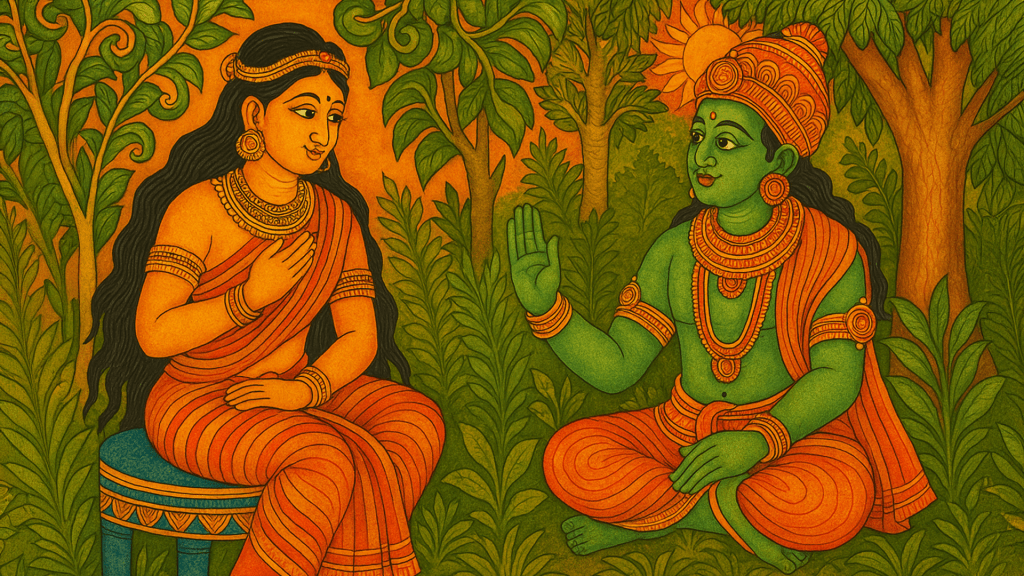
In the solitude of the forest, Shikhandini met a Yaksha — a mystical, compassionate being who saw her pain and did not flinch. He did not ask her to explain or justify. He simply listened. And then, he gave her a gift — not of magic, but of recognition. He said: “You deserve to be whole.”
The Yaksha, moved by Shikhandini’s pain and clarity, offered her his own masculine form. And in that sacred exchange of empathy and truth, Shikhandi was born — not just in body, but in spirit and choice.
Shikhandi returned to the kingdom, no longer half-this or half-that — but whole. He fought bravely in the Kurukshetra war and was instrumental in the fall of Bhishma, fulfilling the prophecy. His gender, questioned by all, became irrelevant in the face of his courage and purpose.
Shikhandini’s story is not just mythology. It is a mirror.
Every day, there are people like Shikhandini — born into bodies, boxed into roles, forced into silence. They’re told to “act normal,” to hide their truth to be accepted. To change not for growth, but for comfort — someone else’s comfort.
But what if acceptance isn’t about tolerance at all? What if it’s about awareness? Shikhandini was strong because she embraced who she truly was, even when others couldn’t.
Acceptance is not charity. It is liberation — for both the one being seen, and the one finally seeing. When we accept someone’s identity — their gender, their sexuality, their journey — we are not abandoning tradition. We are living its essence: Compassion, Truth, Awareness.
Shikhandini teaches us that labels mean little when your heart knows who you are. That the fight for identity is not new – it is timeless, sacred, and profoundly human. So when someone comes out — as queer, trans, gay, lesbian,non-binary, or anything in between – don’t ask them to make sense of their existence for your comfort. Let’s expand our world to fit them in.
From the forests of Panchala to modern classrooms, from Sanskrit scriptures to Instagram stories — the longing remains the same:
To be seen, not judged,
To be loved, not labeled.
To be welcomed, not rewritten.
And like Shikhandini, they are not confused.
They are not broken.
They are warriors — fighting not just for identity, but for existence.
Let us not be the society that casts them out.
Let us be the Yaksha — the one who sees their pain and says:
“You deserve to be whole.”
 Mirror Connect
Leave a comment