• Everything You Need to Know About the Quarter Life Crisis

    We’ve all heard of the midlife crisis. It has its own cultural script: the shiny red convertible parked in the driveway, the sudden urge for a dramatic haircut, a new wardrobe, maybe even a reckless fling. By now, it’s more punchline than mystery, a familiar story of someone halfway through life, looking back with a restless sense of ‘is this all there is?

    But what we talk about far less is the quarter-life crisis. A quieter, subtler kind of reckoning that often strikes in your twenties or early thirties. It doesn’t come with bold purchases or radical reinventions. Instead, it shows up in the spaces between milestones: fresh out of university, trying to land a job that feels like more than a paycheck; living alone for the first time while still half-listening to your parents’ advice; expected to act like an adult but rarely treated like one.

    This stage is disorienting. You’re balancing ambition with uncertainty, independence with the weight of other people’s expectations. And beneath the surface, there’s a constant hum of doubt: Shouldn’t I have more figured out by now?

    That quiet tension, rarely named and often dismissed, is the quarter-life crisis. And it’s time we start paying closer attention to it.

    What is a Quarter-Life Crisis?

    A quarter-life crisis is a period of uncertainty, self-doubt, and internal questioning that often arises in a person’s mid-20s to early 30s. Psychologists describe it as a response to the pressures and expectations of early adulthood, as individuals navigate career paths, relationships, finances, and identity all at once. Unlike a midlife crisis, which is typically rooted in looking back with regret or longing, a quarter-life crisis is more about looking forward and feeling overwhelmed by choice.

    It can feel like standing at a crossroads with too many directions, each one carrying the weight of permanence. Do you pursue a stable job or hold out for something more meaningful? Should you move cities, commit to a relationship, or save for a future you’re not even sure you want? The sheer number of possibilities can create paralysis, leaving people stuck between the fear of making the wrong choice and the pressure to keep moving forward.

    This is not just casual overthinking. Studies have found that many young adults report heightened levels of anxiety, loneliness, and stress during this period, even when they appear “successful” from the outside. It’s the contrast between external progress and internal uncertainty that makes the quarter-life crisis so distinct, and so often invisible.

    Why It Happens

    The quarter-life crisis doesn’t appear out of nowhere. It’s shaped by the realities of modern adulthood, where the timeline of what life is “supposed” to look like has become less predictable and more pressurized.

    Career is often the first fault line. At this stage, people are expected not only to have a job but also to find work that is financially secure, socially impressive, and personally fulfilling, an impossible combination for most. You may land the role you thought you wanted, only to realise it doesn’t feel like purpose. Or you may still be searching, watching peers climb ladders on LinkedIn while you’re sending out résumés.

    Finances compound the stress. For many, rent consumes a disproportionate share of income, student loans linger in the background, and milestones like buying a home or building savings feel more like distant fantasies than attainable goals.

    Then there are relationships, balancing friendships that scatter across cities, dating in a culture that prizes endless choice, and navigating family expectations that don’t always align with individual priorities. The result is a constant tension: craving independence, yet still feeling tied to other people’s definitions of success.

    Social media intensifies all of this. It creates a magnified feed of comparison, where someone else’s highlight reel becomes the yardstick for your own progress. The casual post about a promotion, engagement, or world trip can easily spark the question: Am I already behind?

    All of these forces collide at once. The freedom of early adulthood, to live anywhere, pursue any path, start over if needed, coexists with the crushing responsibility of making those choices “count.” It’s that paradox of unlimited possibility paired with unrelenting pressure that makes the quarter-life crisis so uniquely disorienting.

    How It Feels

    The quarter-life crisis isn’t always dramatic. More often, it’s subtle, a low-level hum of unease that follows you through daily routines. It can feel like restlessness without a clear source, or like standing in a crowded room and sensing everyone else has directions except you.

    Anxiety is common. Small decisions, what city to live in, whether to stay in a job another year, whether to invest in a relationship, can feel impossibly heavy. Even everyday choices, like scrolling rental listings or comparing phone plans, can suddenly carry the weight of what kind of life am I building?

    There’s also identity confusion. After years of being defined by education, family, or early ambitions, many people arrive at this stage and realise they’re not entirely sure who they are outside of those structures. The question of “who am I becoming?” feels exciting and terrifying in equal measure.

    And then there’s the lingering sense of being behind. You know, rationally, that everyone’s timeline is different, but it doesn’t always silence the voice that compares your reality with the polished milestones of others. A friend’s engagement, a sibling’s career leap, a classmate’s Instagram-perfect travels can trigger the quiet thought: Should I be there too?

    These feelings don’t always look like a crisis from the outside. They often look like someone functioning well, working, socialising, and showing up. But internally, it can feel like the ground is shifting faster than you can catch your balance.

    How to Recognise and Navigate It

    The easiest way to spot a quarter-life crisis is not in the dramatic moments, but in the dissonance between where you are and where you thought you’d be by now. Plans that once felt certain start to feel misaligned. Achievements that should feel satisfying land flat. Even the future you imagined for yourself might no longer feel like it fits.

    That gap between expectation and reality is often the first sign. From there, the crisis can take many shapes: second-guessing decisions you once made confidently, an urge to abandon stable paths for fear of being trapped, or an ongoing discomfort that you’re living by someone else’s script.

    Addressing it requires active, intentional steps rather than waiting for clarity to arrive on its own. Some ways forward include:

    • Journaling: Writing down your thoughts can take them out of the endless loop in your head and place them where you can actually see them. Often, what feels overwhelming in your mind looks far more manageable on paper. Journaling doesn’t solve the crisis overnight, but it creates clarity, turning noise into patterns, questions into themes, and feelings into something you can work with.
    • Therapy or Counselling: A professional perspective can help untangle the layers of expectation, fear, and uncertainty that fuel a quarter-life crisis. It’s not about “fixing” you but about creating space to explore what’s underneath.
    • Open Conversations: Talking honestly with friends or peers can reveal how common these feelings actually are. What often feels like a private failure is, more often than not, a shared experience.
    • Reframing Expectations: Part of the crisis stems from the pressure to have everything figured out early. Reminding yourself that growth is rarely linear and that detours are not wasted time can help ease that pressure.
    • Self-Compassion: Instead of judging yourself for feeling lost, acknowledge that uncertainty is part of being human. Treat yourself with the same patience you’d extend to a friend in your position.

    Why We Should Start Addressing It

    For too long, the quarter-life crisis has been brushed aside as “just a phase” or reduced to a punchline about indecisive twenty-somethings. But ignoring it doesn’t make it disappear; it only makes people feel more alone in their experience.

    Naming it matters. When you recognise that what you’re going through has a shape and a name, the sense of isolation softens. You realise that uncertainty at this stage of life is not a personal flaw, but a shared reality for many.

    Acknowledging it also shifts the narrative. Instead of treating uncertainty as failure, it reframes it as a natural part of growth. Few people step into adulthood with a fully formed plan that never changes; questioning, recalibrating, and even starting over are part of building a life that actually fits.

    And perhaps most importantly, addressing the quarter-life crisis opens the door to healthier ways of coping. It invites conversation, reflection, and tools, whether through journaling, therapy, or honest dialogue with peers, that transform a silent struggle into an opportunity for clarity and resilience. By talking about it openly, we turn the quarter-life crisis from something isolating into something connective, even empowering.


  • 10 Healthy Ways to Cope With Failure

    As the saying goes, “If at first you don’t succeed, try, try again.”

    It sounds simple enough, almost like a neat little mantra tucked into childhood classrooms and motivational posters. When we set goals, of course, we want to achieve them. Why else would we pour in our time, effort, and energy? Yet the truth is, success rarely happens in a straight line. More often than not, we stumble, fall short, or watch things unravel in ways we never anticipated. Failure, as every wise voice reminds us, is part of the process.

    And still, knowing that doesn’t make it any easier. We’ve been told failure builds character, that it teaches resilience and grit. But when it arrives at our doorstep, whether it’s a rejection email, a project that collapses, or a personal goal that slips out of reach, it doesn’t feel like a teacher. It feels heavy, sharp, and deeply personal.

    That’s not because humans are wired to resist truth, but because failure touches something tender: our sense of identity, our worth, our belonging. To fail isn’t just to miss a target; it can feel like evidence that we aren’t enough. And that is what makes it so difficult to accept.

    Which is why the more useful question isn’t why failure hurts, but how we can learn to cope with it in healthier, more compassionate ways.

    1. Let yourself feel it

    Failure is uncomfortable, and the instinct is usually to push those feelings away. But ignoring them doesn’t make them disappear—it just buries them deeper. Permitting yourself to acknowledge disappointment, frustration, or embarrassment is the first step toward processing what happened.

    One practical approach is to name the emotion directly: “I feel let down,” or “I feel angry at myself.” This simple act of recognition helps regulate emotions and prevents them from spiralling. It creates a foundation for healthier coping strategies later.

    2. Notice when avoidance turns harmful

    Taking a break after a setback is healthy. But there’s a fine line between rest and avoidance. When distractions, like scrolling endlessly, overworking, or numbing out, become a way of pretending the failure didn’t happen, they keep you stuck.

    The key is noticing whether your chosen “break” leaves you feeling restored or more drained. If it’s the latter, it may be a sign you’re avoiding rather than recovering. Awareness of this distinction is what allows resilience after failure to take shape.

    3. Reframe failure as learning

    Failure often feels like the end of the road, but in reality, it’s information. Instead of labelling it as proof that you’re not good enough, look at what it’s showing you. Did a method fall short? Did timing play a role? These questions help you reframe failure as learning rather than defeat.

    This perspective is what allows you to bounce back from failure more effectively. Shifting from “I failed” to “I learned” doesn’t erase the difficulty, but it does turn it into progress you can carry forward.

    4. Use journaling as a tool

    When emotions feel overwhelming, writing them down provides clarity. Journaling for mental health is not about keeping a perfect record; it’s about giving your thoughts a safe place to land. Putting words on paper can help untangle what feels heavy and reveal patterns you didn’t notice before.

    Even short daily entries can guide you toward healthier coping strategies for failure. Over time, the practice becomes both a form of self-care and a roadmap for resilience.

    5. Practice stress management techniques

    Failure puts the body into stress mode—racing thoughts, tense shoulders, restlessness. Without tools to manage that response, it becomes harder to think clearly. Simple practices like deep breathing, grounding exercises, or short walks can regulate the nervous system and steady your perspective.

    These stress management techniques don’t erase the failure, but they give you the calm needed to face it. Think of them as a reset button, allowing you to approach setbacks with more balance.

    6. Break it into micro failures

    Not every failure is catastrophic. Sometimes it’s a series of smaller missteps along the way. Learning to accept these micro failures is part of building resilience. Instead of waiting for one big moment to define your progress, see each small stumble as a test run that sharpens your skills.

    This mindset reduces the pressure of perfection. Over time, it trains you to see failure not as an obstacle, but as a series of adjustments leading you closer to where you want to be.

    7. Reconnect with your values

    When failure shakes confidence, it often creates a sense of being lost. Re-centring on your values, what truly matters to you, helps you regain direction. Ask yourself: what was I trying to achieve, and why does it matter to me?

    Resilience after failure comes from remembering that one setback doesn’t erase your purpose. Realigning with your core values steadies you, even when the external outcome falls short.

    8. Seek perspective outside yourself

    Coping with failure is harder when you’re caught in your own echo chamber of self-criticism. Talking it through with someone you trust, a friend, mentor, or therapist, can break that cycle. Often, others see effort and progress where you only see mistakes.

    External perspective not only eases self-judgment but also offers practical insights. What feels like a dead end to you may look like a redirection to someone else.

    9. Prioritise recovery through self-care

    Failure takes both an emotional and physical toll. Recovery requires intentional self-care, sleeping well, eating nourishing food, exercising, or even simply taking a walk outside. These aren’t luxuries; they’re ways to restore balance.

    Self-care for failure recovery ensures you have the energy and clarity to process what happened. Without it, small setbacks can feel much larger than they are.

    10. Create a forward plan

    The final step is moving forward. Overcoming failure means shifting from reflection into action. Break your next steps into small, manageable goals, ones you can realistically achieve. Each small win builds momentum and confidence.

    This process helps you bounce back from failure with direction rather than drifting in self-doubt. Planning isn’t about erasing the past; it’s about giving yourself a future to work toward.

  • Why a Goodnight’s Sleep is Essential for Mental Health

    The day has barely begun, but already it feels like a losing battle. The alarm clock might as well be a siren. The coffee tastes dull, the sunlight too bright, the commute more taxing than usual. With too little sleep, even the smallest inconveniences seem magnified. The mind feels heavy, the body slower, as though every thought is wading through fog. It’s easy to joke about waking up on the wrong side of the bed, but anyone who has truly carried the weight of sleep deprivation knows it’s more than a bad mood.

    It isn’t only about physical fatigue. In the quiet background of a restless night, the brain’s intricate machinery misses its chance to restore itself. The balance between emotions and rational thought begins to tilt, patience thins, and anxiety has more room to grow. Over time, this fragile equilibrium. so vital to mental health, can unravel. Researchers describe the link between mental health and sleep as a loop: poor rest fuels stress, anxiety, or depression, which in turn make it harder to sleep; an endless, exhausting cycle.

    The irony is that society often treats reduced sleep as a badge of honour, proof of productivity or resilience. Yet the quiet truth is that good sleep hygiene for mental health is not indulgence; it’s survival. And perhaps, in understanding how the night shapes the mind, one might also learn how to reclaim both.

    Why Sleep Matters for the Mind

    Sleep is not simply the body’s way of pressing pause; it’s maintenance for the mind. In those quiet hours, the brain processes memories, balances hormones, and regulates the emotions that shape the following day. Without that restoration, the effects are quick to appear: concentration slips, moods become unpredictable, and small frustrations start to feel overwhelming.

    The connection between mental health and sleep is closer than most realise. Poor sleep disrupts the brain’s ability to manage stress and respond calmly, while ongoing anxiety or low mood can make it harder to fall asleep in the first place. It’s a cycle that feeds itself, often leaving a person both mentally and physically drained. This is where the art of sleep hygiene for mental health matters; not as a checklist, but as an act of self-preservation.


    Most Common Sleep Disorders

    While the occasional restless night is normal, persistent difficulty falling asleep, staying asleep, or feeling rested can signal an underlying sleep disorder. These conditions can significantly impact both physical and mental health, often going undiagnosed for years. Here are some of the most common ones:

    Insomnia

    One of the most widespread sleep disorders, insomnia involves difficulty falling asleep, staying asleep, or waking up too early and being unable to fall back asleep. It can be short-term (triggered by stress, travel, or illness) or chronic, lasting for months or longer. Factors such as anxiety, depression, poor sleep hygiene, and irregular schedules often contribute. Over time, chronic insomnia can heighten the risk of mood disorders, weaken immunity, and impair cognitive function.

    Sleep Apnea

    Sleep apnea is a condition where breathing repeatedly stops and starts during sleep, often without the person realising it. The most common type, obstructive sleep apnea, occurs when throat muscles intermittently relax and block the airway. Symptoms include loud snoring, gasping for air, and excessive daytime sleepiness. Left untreated, it can increase the risk of high blood pressure, heart disease, stroke, and memory problems, making diagnosis and treatment critical.

    Restless Legs Syndrome (RLS)

    Restless Legs Syndrome is a neurological condition characterised by uncomfortable sensations in the legs and an irresistible urge to move them, especially in the evening or at night. This can make it difficult to fall asleep and stay asleep, leading to chronic sleep deprivation. RLS can be linked to iron deficiency, pregnancy, or certain chronic diseases, and often requires both lifestyle changes and medical management.

    Narcolepsy

    A rare but serious disorder, narcolepsy disrupts the brain’s ability to regulate sleep-wake cycles. People with narcolepsy may experience overwhelming daytime drowsiness and sudden “sleep attacks,” sometimes in the middle of daily activities. Additional symptoms can include cataplexy (sudden muscle weakness triggered by emotions), hallucinations, and disrupted nighttime sleep. Although there’s no cure, medications and scheduled naps can help manage symptoms.

    Circadian Rhythm Sleep Disorders

    These disorders occur when the body’s internal clock, or circadian rhythm, is misaligned with the external environment. Examples include delayed sleep phase disorder, which is common in teens and young adults, causing them to fall asleep and wake up much later than usual or shift work disorder, affecting those who work night shifts or rotating schedules. Misalignment can lead to chronic fatigue, mood changes, and reduced performance.


    The Benefits of Sleep on Mental Health 

    Mood Regulation

    A good night’s sleep is not just rest for the body; it’s a reset button for the mind. During deep sleep cycles, the brain processes emotional experiences, helping you wake up with a clearer head and steadier mood. Without adequate rest, even small stressors can feel overwhelming, and irritability becomes second nature. Consistent, quality sleep ensures that emotional responses are balanced, creating space for more measured, empathetic reactions in daily life.

    Emotional Resilience

    Sleep acts as an invisible armour for your mental wellbeing. It strengthens your ability to handle challenges without feeling emotionally frayed. Well-rested individuals are more adaptable, less reactive, and better equipped to bounce back from life’s inevitable curveballs. This resilience stems from the way REM sleep helps the brain process and neutralise difficult emotions, leaving you better prepared for whatever the day brings.

    Reduced Risk of Mental Health Disorders

    The connection between sleep and mental health is undeniable. Chronic sleep deprivation has been linked to a higher risk of anxiety, depression, and mood disorders. By protecting and prioritising your sleep schedule, you’re not just avoiding fatigue; you’re actively safeguarding your mental wellbeing. Good sleep hygiene becomes a preventive measure, reducing vulnerability to mental health challenges and fostering long-term psychological stability.

    Cognitive Function

    Think of sleep as the ultimate productivity tool. Adequate restorative sleep enhances concentration, decision-making, and memory retention. Without it, the brain struggles to filter and store information, making it harder to focus or think creatively. High-quality sleep optimises your brain’s performance, ensuring you can tackle both work and personal life with clarity and precision.

  • The Different Professions of Mental Health

    There was a time when the phrase mental health lived in the shadows, spoken in hushed tones or not at all. Conversations about anxiety or depression were quickly folded away like an embarrassing family secret, filed under “things we don’t discuss.” The ultimate taboo. The greatest sin. But the world is changing. Cafés now host open mic nights where strangers read poetry about their panic attacks. Workplaces organise mindfulness sessions between budget meetings. Streaming platforms release shows that dare to talk about therapy without turning it into a punchline.

    And yet, as the curtain lifts and society begins to see mental health care for what it is, essential, non-negotiable, as routine as a dental check-up, knowing who and where to turn has become all the more essential. Psychiatrists, psychologists, therapists, counsellors, behavioural health specialists- the list goes on. As it does, the titles begin to blur and their roles overlap in a haze of professional jargon. So, the question becomes less about whether to seek help and more about understanding which voice, in this crowded room of expertise, is the one you need to hear first.

    The Many Faces of Mental Health

    Psychologists

    Far from the outdated caricature of a patient reclining on a couch, psychologists bring rigorous academic training and clinical expertise to the table. Holding doctoral degrees such as a Ph.D., Psy.D., or Ed.D., and licensed through state boards, they address a spectrum of mental health concerns, from depression and PTSD to eating disorders and learning difficulties.

    Unlike psychiatrists, psychologists do not prescribe medication in most states. Instead, they focus on therapies grounded in research, combining talk-based approaches with diagnostic assessments. Their work spans private practice, hospitals, schools, and increasingly, online platforms- a shift accelerated by recent years, where hybrid therapy has become the norm for nearly half of all practitioners.

    Psychiatrists

    A mental health professional with a medical degree, i.e., either an MD or DO, is known as a psychiatrist and is uniquely positioned to bridge mind and body. They diagnose, treat, and prevent mental, emotional, and behavioural disorders, often integrating medication with psychotherapy.

    Specialisations can be highly specific, including: 

    • Child and adolescent psychiatry
    • Forensic psychiatry
    • Neuropsychiatry 
    • Sleep medicine
    • Pain medicine

    While a general practitioner can prescribe psychiatric medication, complex or treatment-resistant conditions often require the insight of a psychiatrist, who can tailor interventions through a combination of medical evaluation, lab testing, and psychiatric expertise.

    Psychoanalysts

    Rooted in the work of Sigmund Freud, psychoanalysts focus on what lies beneath — the unconscious drives, anxieties, and patterns that quietly shape behaviour. Using tools such as free association and dream interpretation, they aim to surface the deeper conflicts influencing a person’s life.

    While “psychoanalyst” is not a legally protected title, credible practitioners undergo years of specialised training beyond a graduate degree, often earning certification from recognised bodies like the American Board of Psychoanalysis or the International Psychoanalytical Association. For some, psychoanalysis offers a slower but profound path to self-understanding.

    Therapists and Counsellors

    The terms often appear interchangeably, but there are distinctions. “Therapist” is a broad category, encompassing professionals with a masters-level training in fields like counselling, marriage and family therapy, or clinical social work. “Counsellor” tends to imply a more targeted approach, focusing on specific life challenges rather than the treatment of severe mental disorders.

    Within this group, mental health counsellors address a wide range of emotional and relational issues; marriage and family counsellors work to resolve conflicts in domestic settings; addiction counsellors guide recovery from substance use or behavioural dependencies; and religious counsellors integrate spiritual frameworks into emotional support. While their methods differ, the goal is the same: to help people navigate difficulty and restore balance.

    Psychiatric Nurses

    Behavioural health specialists are not limited to physicians or therapists. The field can also include psychiatric nurses, who play a vital role in patient care. These registered nurses, with additional training in mental health, often work in hospitals, correctional facilities, residential programs, or community clinics.

    They administer medication, provide therapeutic support, and manage complex behaviours. In some regions, psychiatric nurse practitioners can prescribe medication, offering critical access to treatment in areas where psychiatrists are scarce. Despite their importance, psychiatric nursing faces a recruitment challenge- only a small percentage of nursing students commit to it early in their careers.

    Psychotherapists

    Psychotherapy, often called “talk therapy”, is a treatment approach delivered by a range of qualified mental health professionals, including psychologists, clinical social workers, and licensed counsellors. It can involve modalities like cognitive behavioural therapy (CBT), psychodynamic therapy, or acceptance and commitment therapy (ACT).

    What defines a psychotherapist is less their original degree and more their chosen method. Whether helping a person reframe intrusive thoughts or guiding them through unresolved grief, the emphasis is on creating a safe, structured environment for emotional work.

    Art Therapists

    Some therapies bypass words entirely. Art therapists use creativity in the forms of painting, sculpture, collage, and even creative writing as a medium for expression and healing. Backed by research, art therapy can support people living with depression, dementia, psychosis, and trauma.

    These practitioners typically hold a master’s degree in art therapy or a related field, and work in diverse settings from hospitals to schools. For many clients, the act of creating becomes a bridge to self-understanding when traditional conversation feels limiting.

    Social Workers

    Social workers operate at the intersection of individual care and systemic support. In mental health, they address both personal challenges, such as substance use, domestic violence, and housing insecurity, and the broader social factors that influence well-being.

    Specialisations include child and family social work, medical social work, and mental health and substance use. With bachelor’s or master’s degrees in social work and relevant licensure, they are trained to navigate complex systems and connect people to resources, often becoming the anchor point in a fragmented care network.

    The Bottom Line

    The spectrum of mental health professionals reflects the complexity of the human mind. From the precision of psychiatric medicine to the introspection of psychoanalysis, from the structured guidance of counselling to the open-ended exploration of art therapy, each role offers a different entry point into care.

    Knowing these distinctions isn’t just academic. It’s the difference between wandering in uncertainty and taking a first step toward the kind of help that meets you exactly where you are with nothing short of confidence.

  • Why are more men going to therapy, and why does it matter?

    For a long time, therapy sat on the far edges of cultural acceptability, especially for men. It was a room few entered willingly, a last resort after something cracked. The language around it was clinical, sometimes cloaked in shame. And somewhere between the “man up” slogans and the inherited silences, the idea took root that asking for help was an admission of failure.

    But lately, something is shifting. Quietly, steadily, the narrative is being rewritten.

    Across cultures, age groups, and social classes, more men are turning to therapy, not because they’ve run out of options, but because they’re finally being shown that it is an option. Social media has made mental health conversations more visible. Burnout and anxiety are no longer abstract ideas that get left in the abyss. They’re now showing up in bodies, relationships, and everyday decisions men make. And with each generation, the grip of traditional masculinity loosens just a little.

    So, why are more men going to therapy, and why does the act matter more today than ever before?

    What Is Therapy

    Therapy can feel like an unfamiliar language. It’s vague, uncomfortable, even indulgent. What does it mean to sit in a room with a stranger and talk about things you’ve never named?

    At its simplest, therapy is a structured, confidential space, one where men are encouraged to explore what feels confusing, uncomfortable, or quietly overwhelming. As the British Association for Counselling and Psychotherapy puts it, it’s a place to talk about anything “painful or unclear,” without judgment or interruption.

    But that definition barely captures what it becomes for those who stay.

    For many men, therapy becomes a quiet return to emotions that were tucked away, to the parts of themselves they had to abandon in order to “man up.” Masculinity, after all, was rarely defined by presence, but by performance.

    Over time, therapy begins to make a different kind of sense: not a place to fix, but to notice. Not a place for answers, but for questions. Why does anger arrive first? Where does the silence come from? What would it mean not to hold everything alone?

    So, while the practice doesn’t offer tidy resolutions or is filled with dramatic epiphanies, it does allow men to learn to pause without guilt, and above all, hesitation. Where asking a question, about themselves, their past, their patterns, becomes more valuable than having the right answer. And in a culture that still teaches men to measure their worth by how little they need, that kind of space isn’t just rare. It’s quietly radical. And it’s part of a broader, long-overdue shift in how we understand mental health for men.

    Why does therapy for men feel so foreign? 

    If vulnerability is a language, many men were never taught how to speak it. For decades, men and therapy have been positioned as an unlikely pairing. The legacy of stoicism, inherited from war-era masculinity and reinforced by post-liberal economic independence, has cemented a belief: men cope, they don’t crumble. They endure quietly, solve problems alone, and suppress discomfort with control. Vulnerability is viewed not as a form of intelligence but as an interruption of power.

    This narrative has been stitched into everything—from locker room banter to Bollywood’s hypermasculine protagonists, to the absence of male characters who talk about mental health for men without being the punchline. Even today, boys learn early that expressing sadness is suspect. That needing support marks you as dependent. That therapy is for people who are broken, and men don’t break.

    All of it contributes to a slow but steady alienation from the idea of counselling for men. Not because the need doesn’t exist, but because the permission rarely does. Still, cultural codes are shifting.

    Millennials and Gen Z aren’t just inheriting emotional debt; they’re questioning its legitimacy. The rise of digital discourse has reframed how mental health stigma is understood, particularly for men. Instagram therapists, community helplines, and anonymous support forums they’ve made space for language that was once unavailable: burnout, boundary-setting, and emotional regulation. The lexicon is expanding. And so is the courage to use it.

    What’s emerging is not a sudden embrace of vulnerability, but a quiet unlearning. Therapy is no longer a secret. For many, it’s becoming a soft rebellion, a refusal to carry the silence passed down to them.

    The Benefits of Going to Therapy

    Therapy doesn’t offer answers as much as it reshapes the questions. For men raised on emotional suppression, wellbeing often meant composure, not clarity. Feelings weren’t to be explored, only managed or, more often, ignored.

    But therapy opens up emotional fluency. Over time, emotions become intelligible indicators. Grief, rage, joy, shame, and everything else in between begin to carry form and meaning. Emotional wellbeing, then, is no longer the absence of visible distress but the presence of emotional literacy.

    Stress and anger are rarely isolated emotions; they’re often residue from what hasn’t been said or processed. Within masculine codes, they’re among the few feelings allowed public expression, but they’re also the most misunderstood.

    Therapy helps decode them. Instead of asking men to suppress anger or hide stress, it invites them to trace where it begins. Does frustration stem from fear? Does silence come from shame? The goal isn’t emotional control, but comprehension. Patterns become visible, responses less reflexive. What once felt like volatility begins to feel like information.

    For many men, communication has been shaped by absence of many. Factors like modelling, language, and safe spaces to articulate internal states. What develops instead is performance: stoicism as strength, silence as survival.

    Therapy introduces the possibility of expression without threat. Over time, communication stops being a defensive act and becomes relational. It’s not about mastering language, but about becoming available to oneself and others. As emotional awareness deepens, relationships shift too. Intimacy becomes less about exposure, more about resonance.

    Trauma doesn’t always announce itself. Sometimes it lives quietly in the body becoming a reflex to overwork in the discomfort with softness and the urge to control everything. And, unfortunately, men have learned to normalise trauma as if it’s a right of passage. 

    Therapy offers a way to revisit those chapters without reliving them. It doesn’t erase the past, but it loosens its grip. It allows people to begin to see their responses not as flaws, but as patterns that made sense in survival mode, and are no longer needed now.

    Masculine identity has long been framed through function; what one does, achieves, provides. But when worth is tethered to performance, the self beneath it remains unexamined.

    Therapy slows that equation. It shifts the focus from outcome to origin. Not just what a man does, but why. Why certain choices feel like defaults. Why discomfort hides beneath humour. Why success doesn’t always feel like arrival.

    Here, identity isn’t something built overnight. It’s pieced together in layers, some inherited, some outdated, some never chosen at all. Therapy helps separate what was absorbed from what actually aligns. And in that space, a different kind of masculinity can emerge—one rooted not in reaction, but in reflection.

    Final Thoughts

    For so long, masculinity was something inherited in silence and vulnerability was its greatest  threat. But what if silence is no longer a marker of strength, but a symptom of disconnection?

    Men today are stepping into unfamiliar terrain, not because it’s fashionable, but because the old maps no longer work. They’re learning that strength isn’t the absence of pain, but the willingness to face it without armour. That identity isn’t built in isolation, but shaped through reflection, rupture, repair.

    So maybe the question isn’t why should men go to therapy? but rather what becomes possible when they do?

  • 30 Journal Prompts to Help You Meet Yourself More Honestly

    Journaling is an act of honesty between us and ourselves. One that is deeply grounding, and when done with intention, it can be one of the most effective tools for emotional processing, self-regulation, and mental clarity. Thoughts take shape. Emotions start to feel a little more manageable. And over time, those small moments of reflection can lead to meaningful shifts in how you relate to yourself. 

    There’s plenty of research supporting this. According to the American Psychological Association, expressive writing, especially when focused on emotions and personal experiences, can help reduce stress, improve mood, and support better coping. Studies have also shown that digital journaling tools can be helpful in managing symptoms of anxiety, depression, and emotional overwhelm, particularly when used regularly as part of a self-care routine.

    Still, knowing that journaling is helpful doesn’t always make it easier to begin. That’s where prompts come in. A good journal prompt doesn’t try to fix anything. It just gives you a place to start. So, what are some daily journal prompts? Let’s find out. 


    5 Daily Journal Prompts for Self-Reflection

    Self-reflection doesn’t need to be deep or dramatic to be meaningful. A few minutes each day spent checking in with ourselves can strengthen self-awareness, emotional regulation, and decision-making over time.

    Journal prompt: Where did my energy go today? What drained me and what restored me?

    Why it works: This prompt helps us notice how our time and emotional bandwidth were spent, so we can make more intentional choices about where we give our attention.

    Journal prompt: What moment stood out to me today, and what did it bring up?

    Why it works: By identifying a moment that had an impact, big or small, we begin to track what resonates with us and why.

    Journal prompt: Did my mood or mindset shift during the day? What caused it?

    Why it works: Recognising even small emotional shifts helps build emotional literacy and connect the dots between inner and outer experiences.

    Journal prompt: What did I need today, emotionally, mentally, or physically, that I may have ignored?

    Why it works: This prompt strengthens self-attunement by encouraging us to reflect on unfulfilled needs with curiosity, not judgment.

    Journal prompt: What did I handle well today, even if it went unnoticed?

    Why it works: Focusing on small, internal wins builds a sense of self-trust and confidence, especially on days that don’t feel outwardly “productive.”


    5 Mindful Self-Love Prompts

    Self-love is often misunderstood as a feeling. But in practice, it’s more of a relationship. And like any relationship, it’s built through attention, honesty, and care. These journaling prompts aren’t about affirmations or forced positivity. They’re about paying attention to how we speak to ourselves, how we show up for ourselves, and what we believe we’re worthy of.

    Journal prompt: How did I speak to myself today? Would I say the same things to someone I care about?

    Why it works: This prompt helps us notice the tone of our inner dialogue, which is often the starting point for building or rebuilding self-respect.

    Journal prompt: What part of me feels “not enough” today, and can I offer that part some compassion?

    Why it works: It invites us to meet insecurity with understanding, rather than resistance, and practice internal acceptance without bypassing what’s real.

    Journal prompt: What’s one thing I did today that showed care for myself, intentionally or unintentionally?

    Why it works: This encourages us to see self-love as behaviour, not just emotion, and to notice the ways we may already be showing up for ourselves.

    Journal prompt: What story am I carrying about myself that no longer feels true?

    Why it works: By identifying outdated beliefs, we make room for a more current and self-honouring narrative to take shape.

    Journal prompt: Did I say yes when I meant no today? Or no, when I meant yes?

    Why it works: This prompt helps us explore self-trust and agency, key components of sustainable self-love.


    5 Journaling Prompts for Finding Purpose

    The idea of “finding purpose” can feel vague and overwhelming, like it’s something we’re either born knowing or endlessly chasing. But purpose doesn’t always arrive as a lightning bolt. More often, it’s something we notice in small moments that excites us, challenges us, or that feels meaningful over time. 

    Journal prompt: What am I naturally drawn to, even when no one’s asking me to do it?

    Why it works: This prompt helps us identify where curiosity, energy, and inner motivation already exist.

    Journal prompt: What challenge or struggle in my life has shaped the way I show up for others?

    Why it works: Exploring how we’ve grown through difficulty can offer clues about the values or roles that feel purposeful to us now.

    Journal prompt: When do I feel most like myself, without needing to perform or prove anything?

    Why it works: This helps separate genuine fulfilment from external validation, making it easier to recognise what resonates.

    Journal prompt: What impact do I want to have on people or the world around me, even in small ways?

    Why it works: A prompt to reflect on contribution over achievement, shifting the focus to meaning, not metrics.

    Journal prompt: Is there a recurring theme or interest that keeps showing up in different phases of my life?

    Why it works: Looking at long-term patterns can reveal deeper threads of identity, passion, or purpose that we might have overlooked.


    5 Journal Prompts for When You’re Feeling Stressed, Anxious, or Nervous

    When anxiety or stress takes over, the mind often moves fast and without direction. Journaling in these moments creates the necessary space we need to feel steady again. These prompts are designed to slow down racing thoughts, reconnect our minds with our body, and ultimately bring clarity to the experience.

    Journal prompt: What am I feeling right now, physically, mentally, emotionally?

    Why it works: Naming our experiences moves us from vague discomfort to something more tangible and manageable.

    Journal prompt: What part of this situation can I influence, and what’s outside of my control?

    Why it works: This prompt helps untangle urgency and identify where our energy is best spent, which can ease spiralling.

    Journal prompt: What’s the worst that could happen, and what’s most likely to happen?

    Why it works: Writing this out can shrink exaggerated fears back into proportion and bring more balance to anxious thinking.

    Journal prompt: What has helped me feel calmer or more supported in the past, and is any of that available to me now?

    Why it works: This encourages us to draw on our own lived experience instead of reaching for solutions that don’t fit the moment.

    Journal prompt: If I could offer myself some reassurance right now, what would I say?

    Why it works: It invites us to take on a more compassionate internal voice, which is often missing in stressful situations.


    5 Daily Journaling Prompts for Processing Emotions

    Most of us were never taught how to feel our feelings, let alone how to understand them. So we intellectualise, suppress, or rush past them, especially the uncomfortable ones. But emotions, when given space, have information to offer.

    Journal prompt: What emotion am I feeling on the surface, and is there something underneath it?

    Why it works: This prompt encourages us to look past immediate reactions and notice the deeper emotion driving them.

    Journal prompt: Can I locate this feeling in my body? What does it feel like, tight, heavy, warm, tense?

    Why it works: Tuning into the physical sensations tied to emotions helps us process them somatically instead of just intellectually.

    Journal prompt: Was there a moment, thought, or interaction that brought this feeling up today?

    Why it works: Identifying the trigger can help us understand emotional patterns and separate current feelings from past ones.

    Journal prompt: When else have I felt this way, and how did I move through it then?

    Why it works: Retrospection reminds us that we’ve handled hard emotions before, and offers clues about what we may need now.

    Journal prompt: Is there something I can give myself that would help me hold this emotion with care?

    Why it works: This journaling prompt shifts the focus from judgment to compassion, helping us respond to our feelings instead of resisting them.


    5 Journaling Prompts for Self-Trust

    Trust is a rather difficult emotion we as humans experience. And self-trust is even harder to sustain as it erodes over time, through doubt, past mistakes, external pressure, or a pattern of self-abandonment. Having said that, it’s important to remember that self-trust isn’t about having all the answers or always making the right decision. It’s about knowing that we can handle any situation, no matter the cost.

    Journal prompt: Can I recall a time I followed my instincts or decided on my terms? What was the outcome?

    Why it works: Looking back on moments where our inner guidance led to something solid helps remind us that the ability is already there; it just needs reinforcement.

    Journal prompt: What kinds of decisions or situations cause me to doubt myself, and why?

    Why it works: This prompt brings clarity to the areas where self-trust feels fragile, without judgment, just awareness.

    Journal prompt: Are there people, systems, or beliefs that I often prioritise over what I know is right for me?

    Why it works: Naming these patterns is a first step toward reclaiming our voice and noticing where we’ve been taught to outsource our authority.

    Journal prompt: When I know something is right for me, how do I sense it physically?

    Why it works: Building self-trust includes reconnecting with the body’s cues, where intuition often speaks first.

    Journal prompt: How might my choices, boundaries, or relationships shift if I acted from a place of self-trust?

    Why it works: This prompt helps us imagine what life could feel like when our inner voice is the one leading.

  • The Story of Shikhandi: Acceptance Beyond Boundaries

    In the great Indian epic Mahabharata, there lies a lesser-told story — one not often spoken at dinner tables or taught in classrooms, yet one that holds immense power in today’s world.

    It is the story of a child named Shikhandini, born in the kingdom of Panchala.
    Her father, King Drupada, had long prayed for a son who would help him avenge the humiliation he suffered at the hands of Bhishma — a revered and fearsome warrior of the Kuru dynasty. But when a daughter was born instead, disappointment clouded the palace.

    Still, Drupada defied convention. He raised Shikhandini as a son — gave her a warrior’s training, dressed her in armor, and declared to the world: “You are my son.”

    Shikhandini felt the sting of a world that could not accept her truth. It wasn’t the sword she feared, but the silence — the heavy, unspoken rejection of a world more loyal to appearances than authenticity.

    Shikhandini always knew — deep inside — that she was more than what the world saw.
    She didn’t reject herself. The world did.

    As she grew, so did the whispers.
    A princess dressed as a prince? A woman wielding weapons?
    Villages sneered. The court doubted.
    Even Drupada, once bold, began to question his decision.

    Shikhandini was trained to be a warrior, but imprisoned by a world that saw only her form, not her fire. Crushed by expectation and rejection, she left the palace in anguish — not to escape, but to seek. Not to erase herself, but to find herself.

    In the solitude of the forest, Shikhandini met a Yaksha — a mystical, compassionate being who saw her pain and did not flinch. He did not ask her to explain or justify. He simply listened. And then, he gave her a gift — not of magic, but of recognition. He said: “You deserve to be whole.”

    The Yaksha, moved by Shikhandini’s pain and clarity, offered her his own masculine form. And in that sacred exchange of empathy and truth, Shikhandi was born — not just in body, but in spirit and choice.

    Shikhandi returned to the kingdom, no longer half-this or half-that — but whole. He fought bravely in the Kurukshetra war and was instrumental in the fall of Bhishma, fulfilling the prophecy. His gender, questioned by all, became irrelevant in the face of his courage and purpose.

    Shikhandini’s story is not just mythology. It is a mirror.
    Every day, there are people like Shikhandini — born into bodies, boxed into roles, forced into silence. They’re told to “act normal,” to hide their truth to be accepted. To change not for growth, but for comfort — someone else’s comfort.

    But what if acceptance isn’t about tolerance at all? What if it’s about awareness? Shikhandini was strong because she embraced who she truly was, even when others couldn’t.

    Acceptance is not charity. It is liberation — for both the one being seen, and the one finally seeing. When we accept someone’s identity — their gender, their sexuality, their journey — we are not abandoning tradition. We are living its essence: Compassion, Truth, Awareness.

    Shikhandini teaches us that labels mean little when your heart knows who you are. That the fight for identity is not new – it is timeless, sacred, and profoundly human. So when someone comes out — as queer, trans, gay, lesbian,non-binary, or anything in between – don’t ask them to make sense of their existence for your comfort. Let’s expand our world to fit them in.

    From the forests of Panchala to modern classrooms, from Sanskrit scriptures to Instagram stories — the longing remains the same:
    To be seen, not judged,
    To be loved, not labeled.
    To be welcomed, not rewritten.

    And like Shikhandini, they are not confused.
    They are not broken.
    They are warriors — fighting not just for identity, but for existence.

    Let us not be the society that casts them out.
    Let us be the Yaksha — the one who sees their pain and says:
    “You deserve to be whole.”

  • The Flute and the Drum

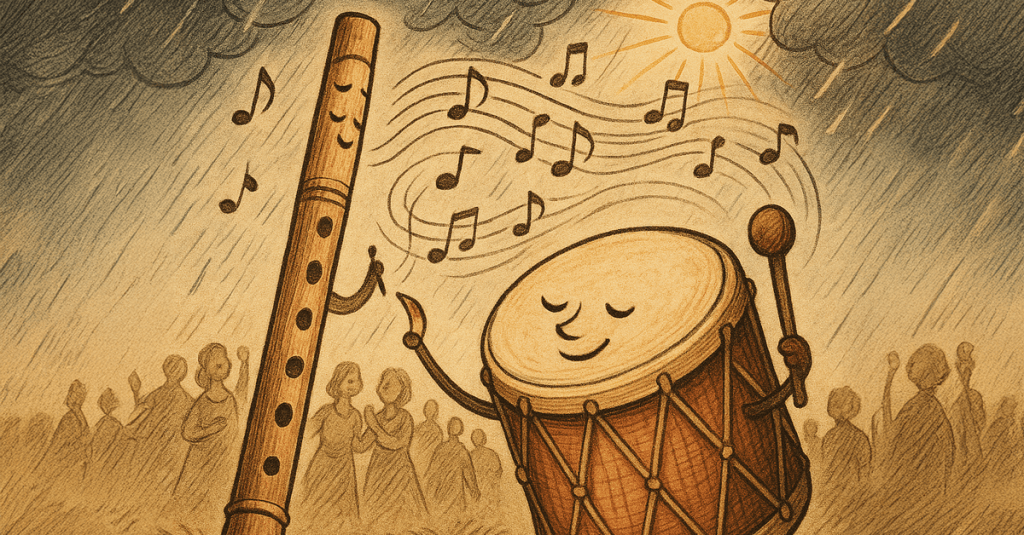
    Once upon a time in a quiet village nestled between the mountains and the sea, lived two musicians—a flute and a drum.

    The flute was delicate and refined. With every breath of wind, she created melodies so sweet that birds would pause mid-flight just to listen. The villagers would often sigh, saying, “Such grace! Such beauty!”

    The drum, on the other hand, was loud and boisterous. His rhythms made children dance and elders tap their feet. His presence was thunderous and bold, and while many admired his energy, some found him overwhelming.

    They both lived in the same music hall, but they rarely played together. The flute thought, “I am too soft. He will drown me out.” And the drum thought, “I am too wild. I’ll ruin her gentle songs.”

    One day, the village faced a great storm. The skies darkened, and fear settled over the people. To lift spirits, the village elder asked for music—a sound that could bring hope.

    The flute tried alone. Her tunes were beautiful, but the wind of the storm swallowed her sound. The drum tried alone. His beats were powerful, but they echoed like thunder, reminding everyone of the storm.

    The elder then asked them to play together.

    Hesitantly, they began.

    The flute released soft, steady notes—like whispers of light. The drum offered a heartbeat beneath her song—grounding and bold. Together, their music danced through the storm, weaving strength with serenity. The villagers gathered, smiling and swaying, their fears slowly melting into joy.

    After that day, the flute and the drum never played alone again.

    Like the flute and the drum, each of us carries a unique rhythm, strength, or perspective. Alone, we offer something meaningful; together, our differences can blend into something richer and more resonant.

    In today’s world—filled with diverse voices, ideas, and beliefs—finding ways to collaborate thoughtfully can lead to deeper understanding and creative solutions. Whether addressing global issues, navigating personal relationships, or working in teams, synergy invites us to respect differences rather than fear them, and to discover opportunities where contrasting strengths complement each other.

    Collaboration doesn’t erase individuality—it values it, allowing each person’s uniqueness to enhance rather than diminish the collective whole. Perhaps, in appreciating this balance, we might better address both personal challenges and wider societal complexities, turning diverse voices into harmonious conversations.

  • The Cracked Pot

    A water-bearer in India had two large pots, each hanging on either end of a pole he carried across his neck. One pot was perfect, but the other had a crack in it.

    Every day, the water-bearer walked down to the river, filled both pots, and walked back home. The perfect pot always delivered a full pot of water, but the cracked pot arrived only half full.

    For two years, this continued daily, with the bearer delivering only one and a half pots full of water to his master’s house. Naturally, the perfect pot felt proud, fulfilling the purpose for which it was made. But the poor cracked pot was ashamed of its own imperfection, miserable it could only deliver half its capacity.

    Finally, after two years of shame, the cracked pot spoke to the water-bearer by the river, saying, “I am sorry. I’m ashamed of myself and want to apologize to you. I have only been able to deliver half my load because of this crack in my side. You’ve had to work extra hard because of my flaw.”

    The water-bearer smiled gently and replied, “Did you ever notice the flowers growing on your side of the path, but not on the other pot’s side? I have always known about your flaw, so I planted flower seeds on your side of the path. Every day, as we walked back from the river, you watered them. Because of you, we have fresh flowers on our table every day.”

    Often, we obsess over our perceived flaws, relentlessly trying to fix or hide them, believing that these imperfections make us less worthy.  This story gently invites us to shift our perspective—to view ourselves with compassion rather than criticism. It reminds us that our flaws and imperfections, the parts we often try to hide or fix, may actually allow beauty to bloom around us.

    Our uniqueness can cultivate beauty, kindness, and growth in ways perfection never could. When we lovingly accept our whole selves, we give permission for our true potential and inner gifts to flourish. In your journey of self-love, remember the cracked pot. Celebrate your imperfections, for they might be watering gardens you’ve yet to notice.